Currently Empty: R0.00

Desalination System Components Explained
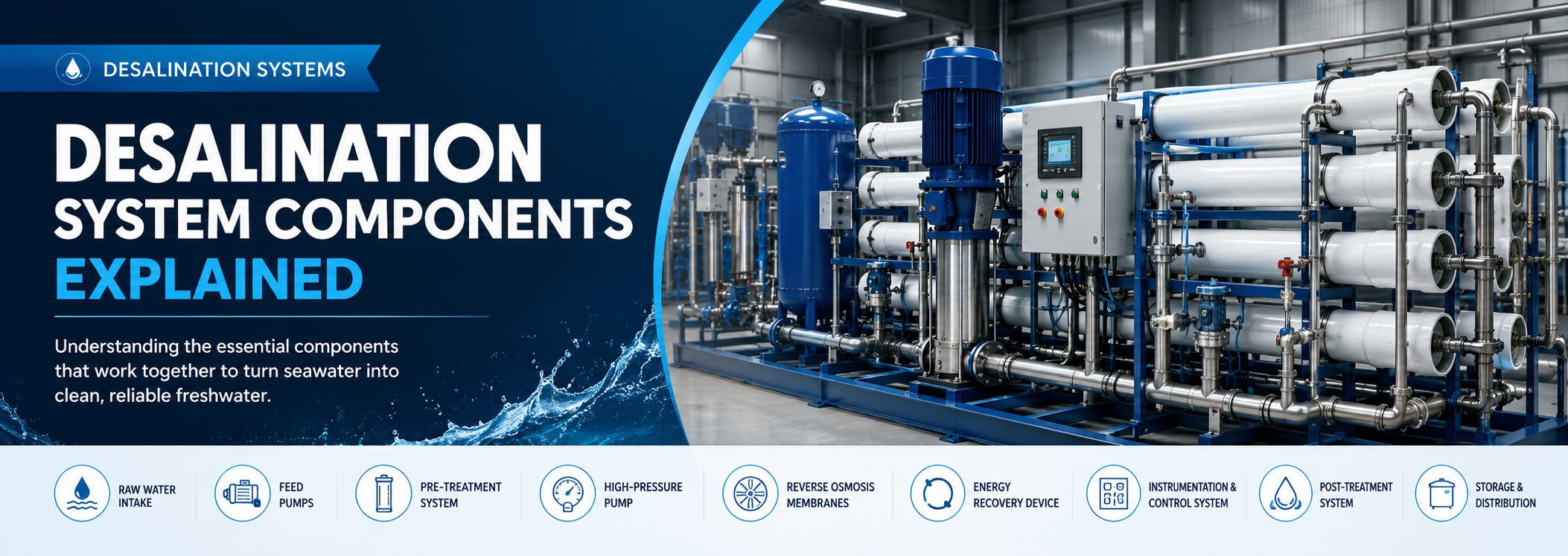
Every desalination system consists of several specialised components that work together to convert seawater or brackish water into fresh, usable water. While reverse osmosis membranes are often considered the heart of the system, they are only one part of a carefully engineered process.
Understanding the main desalination system components helps plant operators, engineers and business owners appreciate how these systems achieve reliable and efficient water production.
Raw Water Intake
The process begins by drawing seawater or brackish water from the source.
The intake system is designed to provide a consistent water supply while limiting the amount of debris entering the plant.
Typical intake structures include the following:
- Open seawater intakes
- Beach wells
- Infiltration galleries
- Subsurface intakes
The choice depends on the water source, site conditions and plant capacity.
Feed Pumps
Feed pumps move raw water through the desalination system at the required flow rate.
They must be carefully selected to match the plant’s production capacity while providing reliable operation under varying conditions.
Modern systems use energy-efficient pumps to reduce operating costs.
Pre-Treatment System
Before the water reaches the reverse osmosis membranes, suspended solids, algae, and fine particles must be removed.
The pre-treatment stage may include the following:
- Coarse screening
- Multimedia filtration
- Cartridge filtration
- Chemical dosing
- Ultrafiltration
Effective pre-treatment protects downstream equipment and helps maintain stable system performance.
High-Pressure Pump
The high-pressure pump is one of the most important desalination system components.
It increases the feed water pressure to a level that allows water molecules to pass through the reverse osmosis membranes while leaving dissolved salts behind.
The required operating pressure depends on whether the system treats seawater or brackish water.
Reverse Osmosis Membranes
Reverse osmosis membranes perform the actual desalination process.
As pressurised water passes through the membrane, salts, dissolved minerals and many other contaminants are rejected, producing high-quality permeate water.
Membrane performance depends on:
- Feed water quality
- Operating pressure
- Recovery rate
- Routine maintenance
Energy Recovery Device
Large seawater desalination plants often include an energy recovery device.
This equipment captures pressure energy from the concentrated brine stream and transfers it back into the system.
Benefits include:
- Lower energy consumption
- Reduced operating costs
- Improved plant efficiency
- Smaller carbon footprint
Energy recovery has become a standard feature in many modern desalination facilities.
Instrumentation and Control System
Automated monitoring allows operators to maintain consistent performance.
Typical instruments monitor the following:
- Pressure
- Flow rate
- Conductivity
- Temperature
- Tank levels
- Pump status
Modern control systems can automatically adjust operating conditions and provide alarms when maintenance is required.
Post-Treatment System
Fresh water produced by reverse osmosis often requires post-treatment before distribution.
Typical processes include the following:
- pH adjustment
- Mineral remineralisation
- Final disinfection
- Storage preparation
Post-treatment ensures the water meets the required quality standards for its intended use.
Storage and Distribution
Once treated, the product water is stored before being distributed to consumers or industrial processes.
Storage systems commonly include:
- Freshwater tanks
- Booster pumps
- Distribution pipework
- Monitoring equipment
Proper storage helps maintain water quality and ensures a reliable supply.
Why Every Component Matters
Each component plays a specific role in maintaining system efficiency.
If one section performs poorly, the entire desalination plant may experience the following:
- Reduced production
- Higher energy consumption
- Membrane fouling
- Increased maintenance
- Higher operating costs
Routine inspections and preventative maintenance help every component operate at peak performance.
Frequently Asked Questions
Which component uses the most energy?
The high-pressure pump typically consumes the largest share of energy because it generates the pressure required for reverse osmosis.
Why are reverse osmosis membranes so important?
The membranes separate fresh water from dissolved salts and other contaminants, making them the core of the desalination process.
Do all desalination plants use energy recovery devices?
Most modern seawater desalination plants include energy recovery devices because they significantly reduce power consumption. Smaller systems may not require them.
Can individual components be upgraded?
Yes. Pumps, membranes, control systems, and energy recovery devices can often be upgraded to improve efficiency and increase production capacity.
Conclusion
A desalination plant is much more than a collection of pumps and membranes. Every desalination system component plays an important role in producing clean, reliable freshwater from seawater or brackish water. By understanding how these components work together, plant owners and operators can improve performance, reduce operating costs and maximise the lifespan of their equipment.
Puritech designs and supplies complete desalination systems, from intake solutions and pre-treatment equipment to reverse osmosis units, energy recovery devices and post-treatment systems. Whether you require a compact installation or a large-scale industrial plant, our team can help deliver a solution tailored to your water production needs.